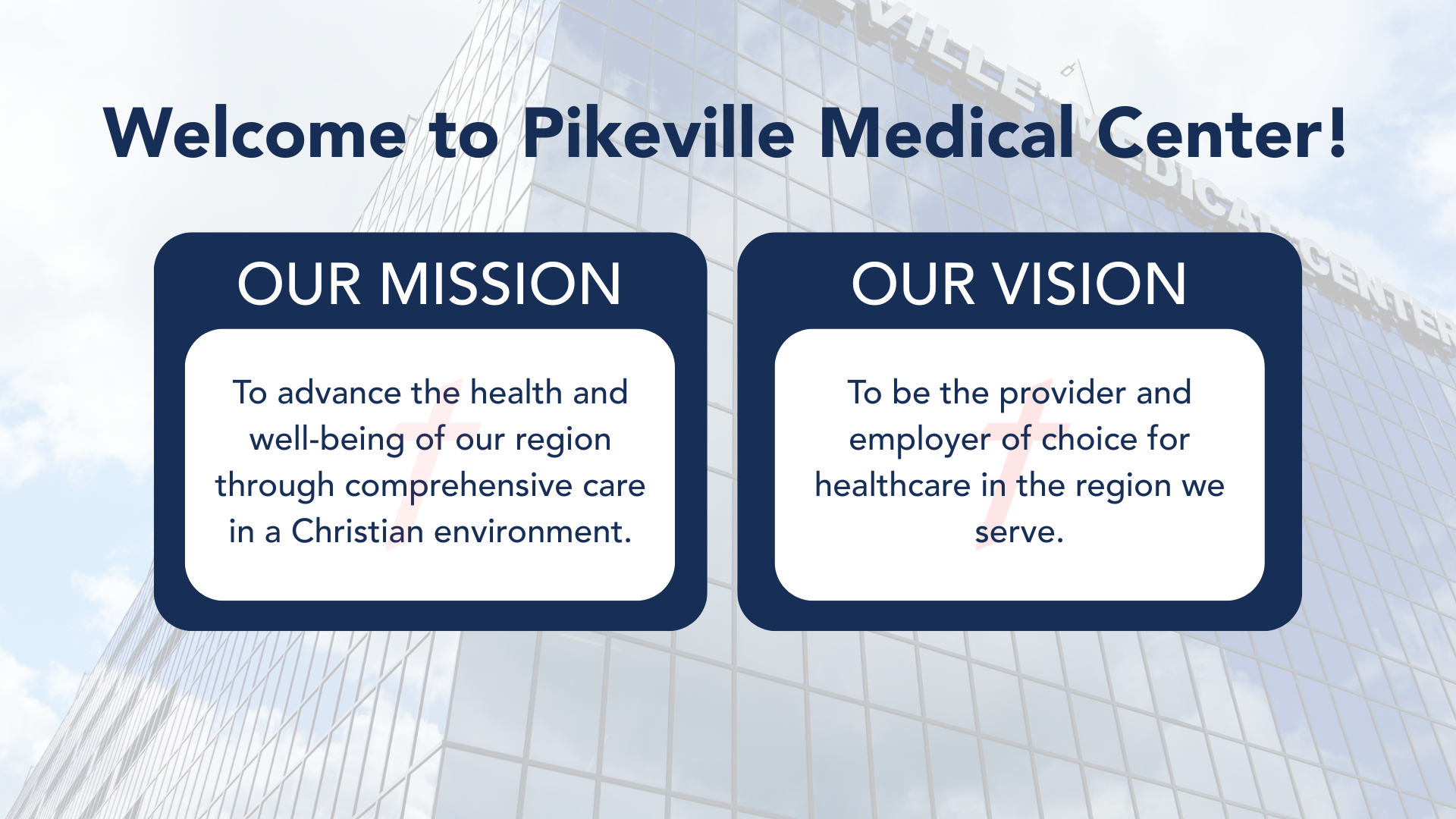
Welcome to Pikeville Medical Center!
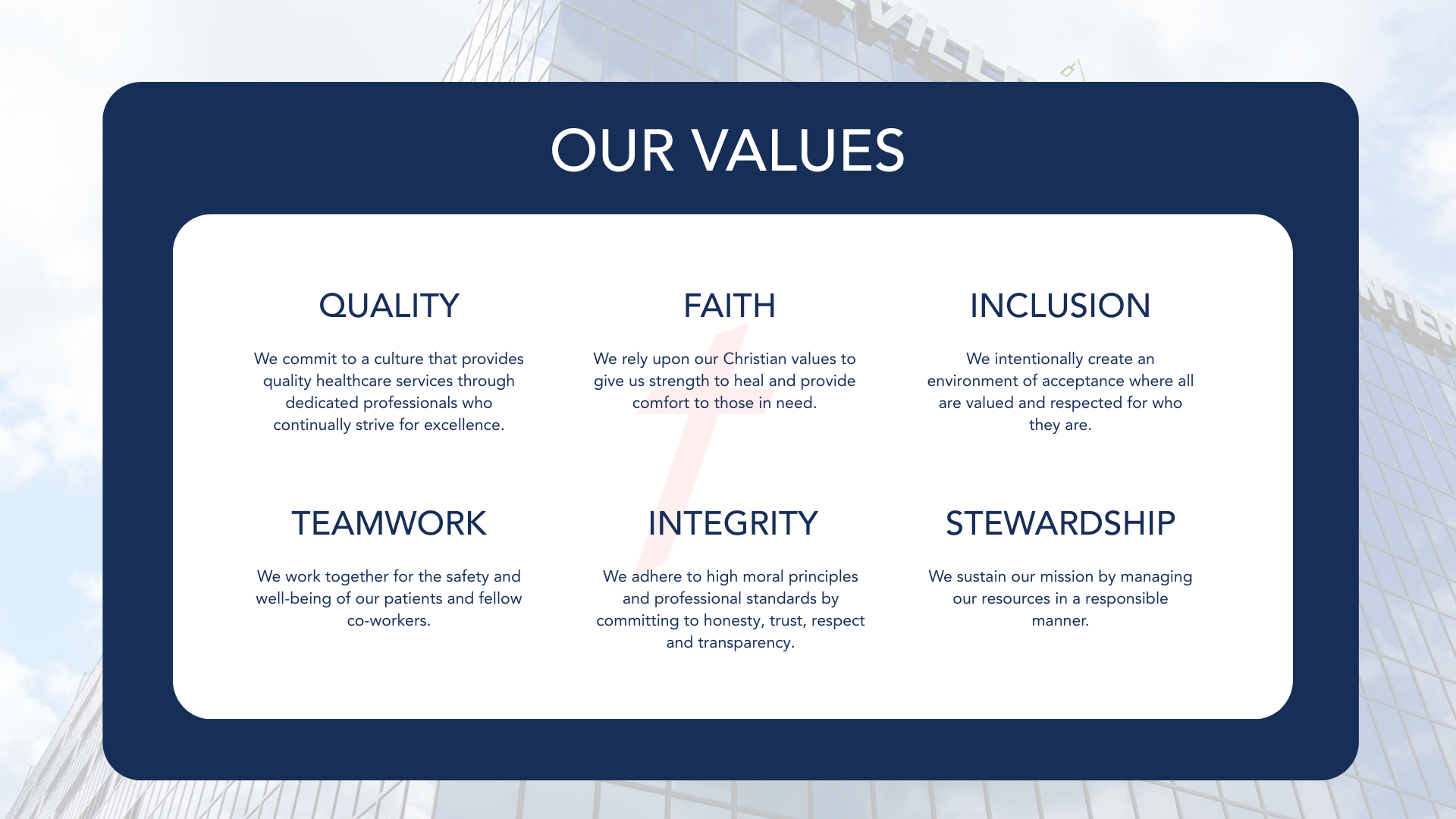
Step 1: Mission, Vision & Values
Step 2: Code of Conduct
Read the PMC Code of Conduct in its entirety before moving to the next step.
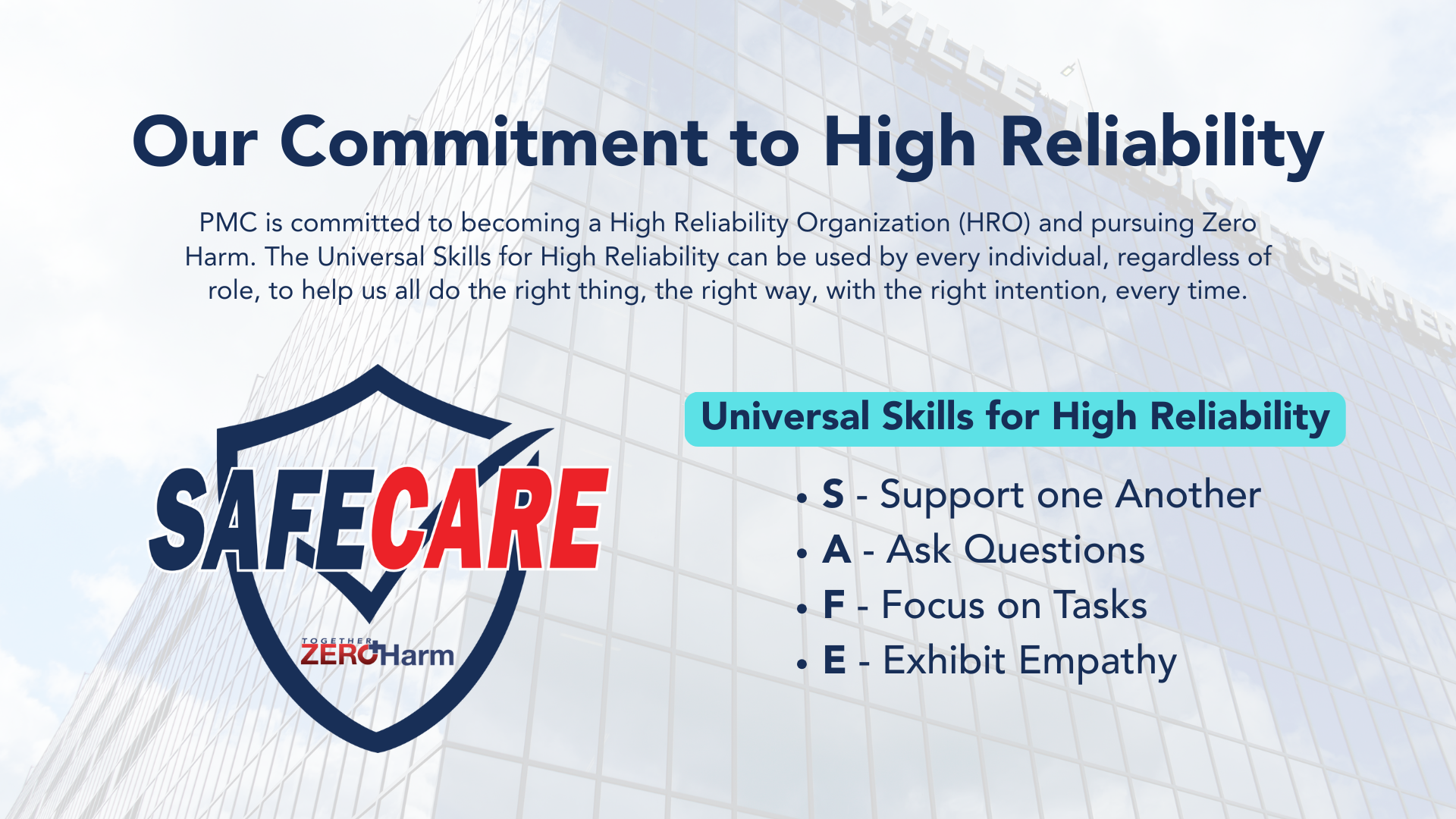
Step 3: SafeCare
Step 4: iCare Model of Effective Communication
Watch the entire video below before moving to the next step.
Step 5: Social Media Policy
Read the entire Social Media Policy before moving to the next step.
You must read the entire Social Media Policy before moving to the next step.
Step 6: Dress Code Policy
Read the entire Dress Code Policy before moving to the next step.
You must read the entire Dress Code Policy before moving to the next step.
Step 7: Tobacco, Vaping & Smoke-Free Campus
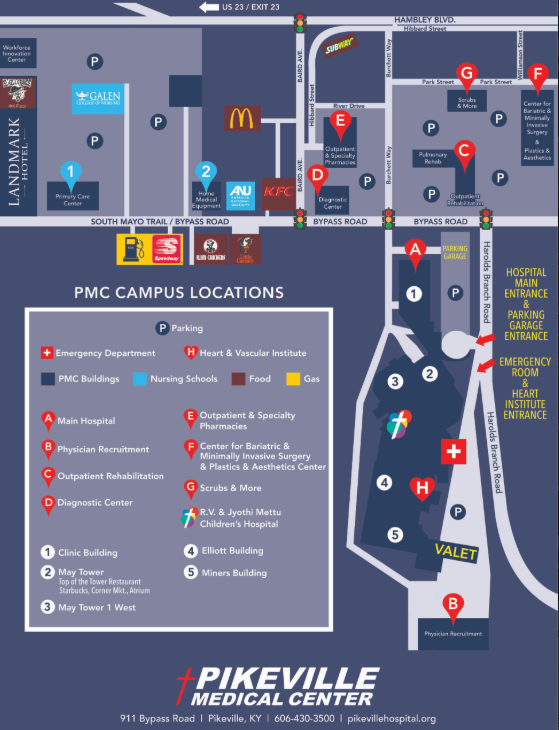
All PMC buildings, structures, entrances and leased properties are smoke/vaping/tobacco-free areas. There are designated areas for smoking which are located across from the Emergency Department entrance. Tobacco is not permitted in any structures; i.e. offices, cafeteria, lounge or parking garage.
Employees may smoke in their personal vehicles only if the vehicle is NOT parked within 30 feet of a PMC structure or in the PMC parking garage.
Step 8: Safety
Safety Hotline: You can report any environmental or patient safety concerns anonymously at 606-430-5830.
Please remember that any employee, physician or other individual who provides care, treatment or services who has concerns about the safety or quality of care provided at Pikeville Medical Center may report those concerns to the Joint Commission. There will be no disciplinary or punitive action against you for reporting safety or quality-of-care concerns to the Joint Commission.
It is the responsibility of department supervisors to obtain Safety Data Sheets (SDS) for chemicals in their respective departments. Copies of SDS must be sent to the Pikeville Medical Center department via courier mail.
Manufacturers, importers, or distributors that supply chemicals or products containing chemicals to our facility are required to supply Safety Data Sheets for those chemicals. The SDSs for this area are kept on file in the Laboratory SDS manuals. Review of the SDS records must be conducted periodically.
SDSs are arranged alphabetically according to the chemical (product) name. A table of contents directs the employee to the department in which the chemical is used and denotes the manufacturer.
Especially hazardous chemicals (toxins, poisons, mutagens, carcinogens) are so labeled in the SDS table of contents.
Use this link to access the Safety Data Sheets: eBinder | Chemical Management
Once your online orientation is completed please login to the PMC Pulse at any PMC desktop to review all safety policies:
1.) Login to home/ or pulse.pmcky.org
2.) Click Apps (located in top right)
3.) Select Ellucid Policy System
4.) Search “Safety Policies” and review all policies in this section because you are responsible for following all policies that apply to your department.
Step 9: Corporate Compliance
Corporate Compliance Hotline: 606-218-3542
Our expectation is for you to become the model of integrity and that you will speak out if you have any concerns. To report a concern or raise a question, contact:
- Compliance Officer
- Director of Internal Audit
- Compliance Hotline 606-218-3542 or online form available on the company intranet
Step 10: Reporting Abuse and Neglect
Review the policy below. If you have questions, contact PMC Risk Management at risk@pikevillehospital.org or 606-430-3534.
Step 11: Joint Commission Orthopedic Certification
Joint Commission Orthopedic Certification
PMC has a Joint Commission Disease Specific Certificaion For:
- Total Hip Replacement
- Total Knee Replacement
- Hip Fracture Care
What does this mean?
It means that not only do we think we provide excellent orthopedic patient care, so does the Joint Commission.
Re-Certification:
The joint commission surveys our programs every two years. Our initial certification for Knee Replacement, Hip Replacement and Hip Fracture was issued in 2016. Our last re-certification was in 2024.
Step 12: Clinical Practice Guidelines
Each program selects Clinical Practice Guidelines which provides the framework for patient care to ensure excellent patient outcomes. Our clinical practice guidelines include:
- Preventing Venous Thromboembolic Disease in Patients Undergoing Elective Total Hip and Knee Arthroplasty, 2011.
- Post Operative Pain Management in Total Knee Arthroplasty, 2019.
- Management of the Hip Fractures in the Elderly, Summary, American Academy of Orthopedic Surgeons, 2014.
Step 13: Nursing Indications
- Neurovascular checks every 4 hours (Hip, Knee, Hip Fracture)
- Use of Polar Pack (Knee Replacement patients)
- Confusion (Delirium) Assessment
- (Hip Fracture Patients) daily
- Pain Management Strategies (including IV Tylenol, Opioids, PCA)
- Early Mobility
- Continuous Passive Motion (CPM) – Knee Patients
- Incentive Spirometer
Step 14: Performance Improvement Measures
- Each program selects four performance improvement measures(two can be non-clinical measures)
- PMC utilizes the ID-PDSA model for performance improvement
- Performance Improvement measures are tracked monthly and reported to program specific committees
- These measures help focus the program staff on areas for improvement and provide better quality care
Specific Performance Measures
- Knee Replacement PI Measures
- Assessment of neurovascular status every four hours
- Assessment of pain with follow-up re-assessment within 60 minutes
- Hip Replacement PI Measures
- Assessment of neurovascular status every four hours
- Assessment of pain with follow-up re-assessment within 60 minutes
- Hip Fractures PI Measures
- Assessment of neurovascular status every four hours
- Assessment of pain with follow-up re-assessment within 60 minutes
Step 15: Connecting Beds to the Nurse Call System
Step 16: Patient Rights and Responsibilities
Review Patient Rights and Responsibilities to understand what is applicable to our patients at Pikeville Medical Center
Step 17: Workplace Violence
Pikeville Medical Center is committed to a safe workplace.
ANY act or threat of violence(verbal, physical, written or online) will not be tolerated. This includes aggression, intimidation, bullying, stalking, or harassment toward staff, patients, visitors or staff.
In an active situation:
- Call the operator for “Dr. Strong” overhead page
- Use panic buttons in high-risk areas
- Request Code Lavender for emotional or spiritual support
- Report incident in RL-Datix Behavioral Tab
Remember:
- No Retaliation for reporting in good faith
- If a restraining order affects the workplace, notify HR and Security
Security Support: PMC Security operates 24/7, providing rapid response to
“Dr. Strong” calls and panic alerts, safety escorts to employees (especially
after dark), de-escalation and emergency response training.
Policy Reference: 8371.1013 Workplace Violence Prevention Plan
Step 18: Patient Safety
Patient Safety
The simplest definition of patient safety is the prevention of harm to patients associated with healthcare. (World Health Organization).
Why is patient safety important?
Medical errors in hospitals and other healthcare facilities are now the third leading cause of death in the United States. By improving patient safety we have the opportunity to save lives.
What’s the difference between patient safety and risk management?
- Patient Safety: involves analyzing a patient safety event that has occurred for lessons that can be learned to prevent future recurrence and thereby improve patient safety. *Includes only patients.
- Risk Management: involves investigation of an incident that has occurred to reduce/eliminate/manage the financial risk to the organization flowing from that incident. Addresses concerns/complaints. *Includes patients, visitors, vendors, contract employees.
It’s always important to remember, when speaking with a patient or patient’s family when discussing their concerns: acknowledge their concerns and make amends.
What is a Patient Safety Event?
A patient safety event is an event that deviated from generally accepted practice/process/procedure oran incident or condition that could have resulted or did result in harm to a patient.
- A patient safety event can be, but not necessarily, the result of a defective system or process design, a system breakdown, equipment failure, or human error.
- Patient safety events can be categorized as adverse events, no-harm events, close calls, or hazardous conditions.
Basic PMC Patient Safety Reporting Process
- Report patient safety events using an electronic reporting tool called RL-Datix.
- An automated email is sent to management to follow up on the event reported.
- The Patient Safety Committee meets weekly to discuss events and follow ups. Understanding WHAT occurred and WHY helps us to improve processes and make patient safety improvement plans.
- Event information is reported to the Patient Safety Organization (PSO), who gives us additional feedback to further improve patient safety.
Patient Safety Event Examples
- Actual:
- Patient fall
- Medication error/reactions
- Patient identifier mistakes
- Missing armbands
- Wrong procedure/wrong site
- Patient leaving AMA
- Incompatible medications infusing together
- Lost dentures
- Pressure injuries/burns
- Handoff issues
- Equipment malfunction
- Near-Miss:
- Multiple IV lines not labeled
- Medication error caught by the nurse performing “5 rights” prior to administration
- Before registering, discovering the wrong birthday/name is on an order/form
- Wrong diet order given to patient, caught before patient received tray
- Expired food/beverages on shelf discovered before giving to patient
- Improper disposal of sharps
Sentinel Events:
Serious patient safety events can be called “Sentinel Events”.
- This is a term by the Joint Commission.
- The Joint Commission accredits PMC, and we utilize this accreditation to participate in the Medicare program.
- Official definition: A sentinel event is a patient safety event (not primarily related to the natural course of the patient’s illness or underlying condition) that reaches a patient and results in any of the following: death, permanent harm, severe temporary harm.
Whose responsibility is it to report a patient safety event and when should it be reported?
- All employees are responsible for reporting patient safety events. Contractors are responsible for collaborating with their Supervisor/Manager to ensure the event is entered in the RL-Datix reporting system. (The person(s) most directly involved or by those who observed or discovered the occurrence.)
- Don’t assume someone else will report it.
- We would rather receive duplicates of an incident than receive no report at all.
- Report as soon as possible, but must be reported in the system before the end of your shift.
- Reports are also able to be written, placed in a sealed envelope, and forwarded to the Patient Safety department, Attention: SAFETY HOTLINE.
SAFETY HOTLINE: You can report any environmental and patient safety concerns anonymously at 606-430-5830. (See Policy A5.0002 Safety Hotline)
Step 19: RL-Datix Tip Sheet
Safety Event Reporting Tip Sheet
The RL-Datix system allows you to report safety events that are related to patients, employees, visitors and workplace violence.
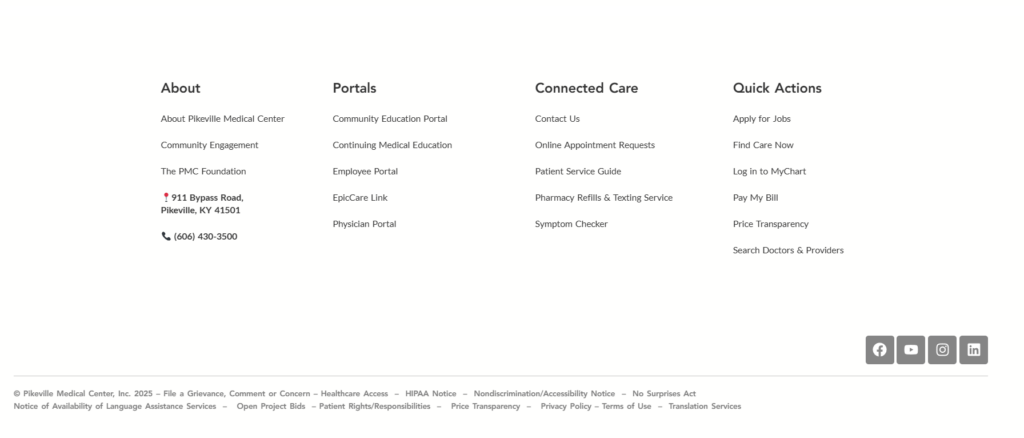
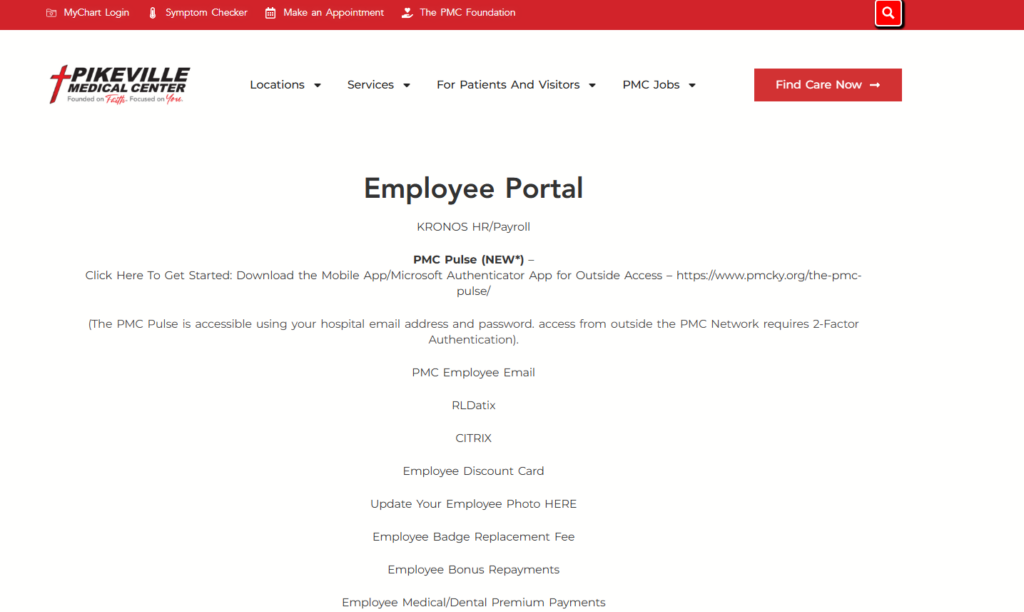
To access, go to www.pmcky.org, scroll to the footer at the bottom of the page, and select Employee Portal. From the Employee Portal, select RL-Datix.
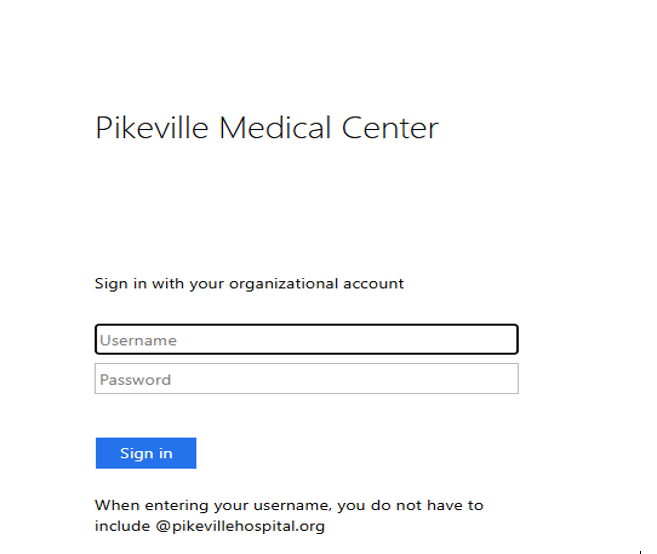
Then you will be prompted to the login screen that will display Pikeville Medical Center. Here you will enter in your username and password.
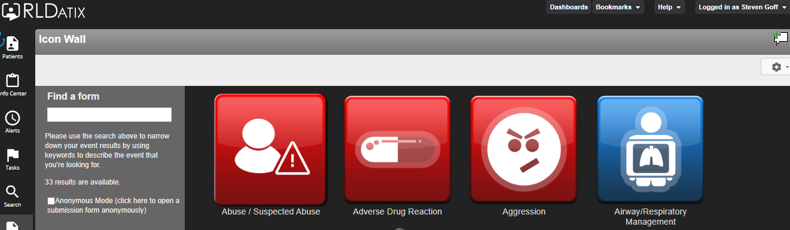
You will then be prompted to the home screen within the RL-Datix Patient Safety reporting system. (Hint: You will automatically be on the Icon Wall Screen).
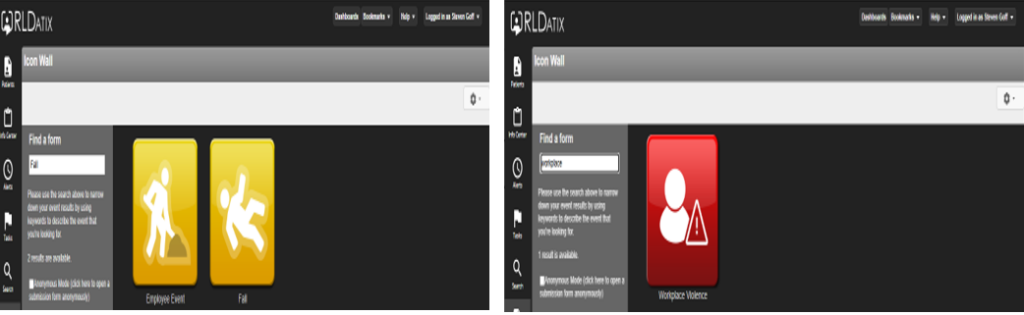
From that screen you can choose the type of safety event that needs to be entered. If you are unsure of the type of Icon to select, you can always use the “Find a form search” located on the screen. This will bring up all Icons that are associated with your search topic. Hint: See examples of searching for “Fall” or “Workplace Violence.”
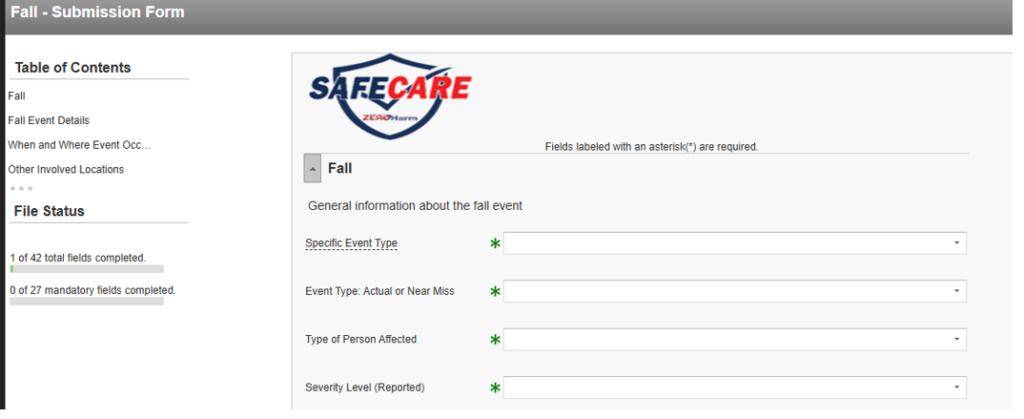
After selecting your icon topic, you will be prompted to the submission form for that safety event. Please remember that all Green are required fields that must be completed.
Once you have completed all the required information you can, simply click on the blue Submit button located at the bottom right-hand corner of the screen.
Please remember if you have any questions or concerns, don’t hesitate to contact the Patient Safety department at 430-3102.
Step 20: Confidentiality
Confidentiality
You are required to keep patient safety and risk management information confidential.
Patient safety information within the Patient Safety Evaluation System (PSES) is referred to as a Patient Safety Work Product (PSWP) and it is privileged and confidential under federal law.
Risk management information, when developed at the direction of an attorney and/or in anticipation of litigation is also privileged (Attorney-Client privilege).
Step 21: Healthy at Work
Healthy at Work
Work-Related Injuries
- If you experience an injury while on duty, contact your employer immediately.
- If your injury requires emergency medical attention or treatment, report to the Emergency Department.
- Notify Employee Health or House Supervisor (if after hours) PRIOR to the end of your shift.
Communicable Diseases
- Notify your supervisor or appropriate contact person if you are sick or experiencing symptoms of a communicable disease.
Masking Policy: Please review our current policy.
Step 22: Customer Service
Chaplain Services:
- Chaplains are available 24 hours per day either in-house or on-call.
- Chaplain services provide:
- spiritual care and emotional support for patients and staff
- devotional materials
- prayer
- sacraments – communion, baptism, anointing of oil, etc.
- 24/7 devotion line (2055)
- Chaplain’s Corner devotions over the announcement speakers and weekly on Sundays via company intranet
Interpretive Services
- PMC uses Lifelinks, which offers both remote video interpreting and telephonic interpreting. Remote video interpreting services are available for American Sign Language. For other languages, PMC uses Lifelinks Telepphonic Interpreting Services.
Diversity Matters: Everyone’s Welcome here!
We do not exclude patients or treat them differently because of race, color, national origin, disability, or sex (including pregnancy, sexual orientation, and gender identity).